Friday, April 1, 2016

The "Pain" Patient

An open letter to the President and Members of Congress...

There have been growing discussions about the "opioid" crisis in the United States resulting in even stricter guidelines for those who prescribe and take opioid medications. The CDC, FDA and DEA believe that their usage does not outweigh the potential risks, not to mention the increasing numbers of addiction issues and overdoses every year. However, making it harder to access these crucial medications are the last resort for many people. People who use opiates illegally will continue to do so, making it that much harder for current physicians and patients who do utilize these medications appropriately.

As a pain patient, there is already a large stigma against us regards to receiving care for pain
management. We are often viewed as "drug seekers" or "addicted" because we need opioids to control such severe pain. I am only 28 years old, but have endured 24 surgeries with a majority of those being in the last 5-6 years alone. I am currently facing 1-2 more surgeries in the near future. I need narcotic medication to control severe pain and to allow me to even function on a limited level. I have a rare, connective tissue disorder that effects everything from dislocating joints, poor healing, frequent and severe infections, nerve damage and even heart valve leaks to name just some of what I endure. Narcotic medication is only part of my medical care. I have been and am a continuous patient in physical therapy trying to strengthen and maintain my body as much as one can as their body breaks down around them. I also have a spinal cord stimulator that helps in managing a chronic and severe pain condition called Reflex Sympathetic Dystrophy or Chronic Regional Pain Syndrome, where even the lightest touch can make you feel as if your body was lit on fire. I take nerve medication, undergo injections, take NSAIDs and am a compliant patient in regards to my medical care. But, I need narcotic medications to allow me to heal from surgery, continue my therapy and be able to function, even in a limited context.

Reading through the new guidelines the CDC proposed in regards to limiting opioid usage broke my heart. I do believe those with addiction issues need help and a great emphasis on mental health needs to be made, but not in the place of pain patient needs. Physician education should also be a larger role than what was advised in caring for patients with chronic needs. As a current pain patient, I am subject to random drug screens (which I have to pay for), random pill counts, one pharmacy to fill my prescriptions through and must keep my doctor informed of ER visits or any other doctor, such as my orthopedic surgeons, who may write a prescription for narcotic medication. I have been a fully compliant patient and have not broken or abused the already stringent process needed so that I may receive pain treatment. Adding more guidelines doesn't necessarily solve the overall issue, but it will make the job for the physicians who still write opioid prescriptions harder and it will cause a greater burden to patients who already have to fight for everything. For patients like myself, a trip to the dentist is even a larger ordeal than most because my genetic condition causes an issue with local anesthetics where it makes them ineffective or you need a larger dose than recommended for even temporary relief. It makes surgeries and already difficult treatment that much harder. Adding more roadblocks is an undue burden we should not have to carry.

Chronic pain patients are much stronger than the public gives us credit. We are able to smile through the pain, when all we really want to do is cry. Despite being at a level of pain which most other people would curl in a ball and quit, we have to keep pushing. We do not "want" to be like this and if we could trade receiving pain medication for the condition that causes the pain, we would without hesitation. When considering how to help those with addiction issues, or any mental health issue, please do not also forget about those of us who need these medications as well...

Tuesday, March 29, 2016

LPAO 8 Dec. 2015

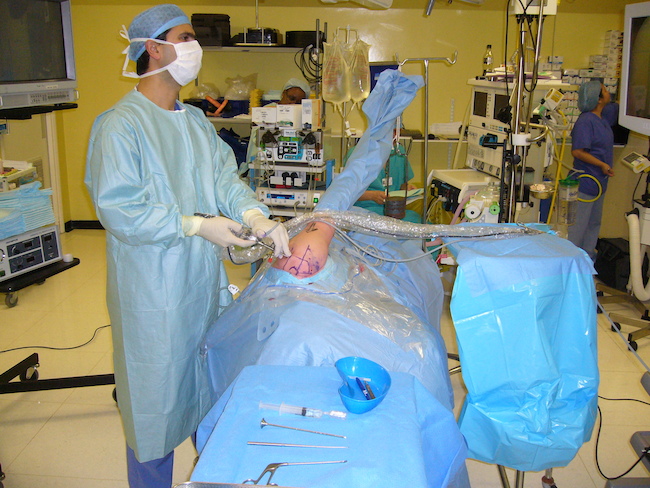
I am currently 16 weeks post-op from my left hip surgery Dec. 8th, 2015. My left hip surgery included an open surgical dislocation entirely through an anterior approach, labral reconstruction with allograft, acetabuloplasty, femoral osteochondroplasty and LPAO. It made for a long day and I was scheduled for about 6 hours. We where concerned with pain management due to the EDS and CRPS. The EDS makes locals and blocks ineffective or wear off much quicker than in the average patient. The docs decided on a lumbar plexus block, spinal block, iliacafascia block with On-Q pump and local anesthetic for the initial first few days post-op. We later learned that the On-Q pump catheter was kinked for the first 2 days in the hip dressing which contributed to the inability to control post-op pain. Dr. Swann even called me the night before surgery to check on me and answer any last minute questions that I had.

The OR was a very busy place between Dr. Swann, the anesthesiologists, nurses, tech reps, etc. It made the process more nerve-wracking then I expected. Originally, the pre-op imaging showed only some labral fraying, but after Dr. Swann was in the joint and the labrum, we where very glad that we planned to have a graft as a back-up because it was completely destroyed. Had we waited much longer for surgery, the left hip would not have been able to be salvaged. Swann was able to reconstruct my labrum, smooth out the femoral head and socket as well as correct my LCEA to 35 degrees. It was a long surgery, but everything was able to be accomplished.

I spent 5 nights in the hospital. Dr. Swann came by every morning to check-in and if he didn't stop in again in the evening he would call or text to check in on me. He placed a woundvac on my incision because of my history, but prior to discharge the wound care nurse decided to change the bandage without consulting with Dr. Swann. Not only was he furious for changing his dressing without notification, but the nurse ended up putting on a dressing that was contraindicated. Dr. Swann advocated for me and made sure the nurse was reprimanded for her behavior. The dressing ended up excoriating my skin leaving it scarred and feeling like my skin had been ripped off. Swann even made a house call that weekend because I was having so many issues with the woundvac and dressing and he didn't want it to wait till the week.

It didn't take too long after the woundvac was removed that my wound re-opened. Not the first time it happened, but I needed up with a different woundvac and a home wound care nurse to help close the incision. I ended up with severe nausea and feeling miserable for the initial weeks post-op. I was so miserable that my protein levels dropped dangerously low. We where unaware that the levels where that low until the wound continued to  re-open and the pain increased. By nearly 4 weeks post-op the wound dehiscence was worsening despite the woundvac, I was miserable with increased pain and felt so sick.

Dr. Swann re-admitted me to the hospital on Jan. 3rd, 2016. I had a hip aspiration done the following day with Interventional Radiology to check for an infection based on my symptoms and history with  infections. After the hip aspiration I went to the OR for Dr. Swann to clean out and re-close my incision. That is when I found out about the low protein levels and had to really increase my daily protein intake or the healing process would continue to be severely compromised. I was 4 weeks post-op and there was no sign of bone growth up to that point. The day after surgery I was sent back down to Interventional Radiology to have a PICC line placed. Although my cultures for infection came back negative, my protein levels where so critically low that I had no immune system and would need strong antibiotics (Vancomycin) to prevent any serious infection as I further recovered. The PICC line and IV antibiotics would be used for at least 4 weeks along with the woundvac to make sure my incision healed and prevent infection or further complications. I spent 4 nights in the hospital before being discharged to go home.

At my 6 week/2 week post-op appointment I was doing a lot better and the x-rays showed some progress in healing with some actual bone growth. I had even lost weight since my LPAO. Those would not be the only road blocks that I would face during recovery. By 10 weeks post-op, although there was a little more bone growth I had developed an inferior pubis ramus fracture. By 12 weeks post-op, the bone growth didn't seem to be progressing as well and what was a stress fracture was quite a visible fracture on x-ray. Dr. Swann prescribed a medication called Forteo that is used to treat osteoporosis, but had been studied and shown good results in healing fractures and non-unions. Unfortunately, insurance denied a prior authorization and 2 appeals by Swann and we are not able to pay the $4,900/mo. for 2 months that I would need the medication. During my 14 week follow-up we did further x-rays that showed minimal healing progress. I would remain on both crutches till 22 weeks post-op, increase my Vitamin D intake and continue to fight insurance for coverage of Forteo. If healing continued with minimal progress, then Dr. Swann would want to further discuss adding additional hardware to stabilize the fractures and promote more healing. Also, because it took 15 weeks for my incision to completely heal, he would not want to re-open a large incision due to my poor healing and would use a guided wire to percutaneously place more hardware to stabilize the fracture sites. To date, I have lost 30lbs since my LPAO. I will also see Dr. Swann again in 2 weeks to check on my bone healing progress. Fingers crossed for significant improvement!!!


Saturday, November 28, 2015

The Season of Sports

Fall is not only the season of sweaters, boots, and pumpkin lattes, but the season of SPORTS! The past few years I have grown into a bigger sports fan than ever before. Following sports, especially while recovering from many surgeries has been a fun outlet.


Over the past 3-4 years I have really gotten into pro hockey with the Chicago Blackhawks being my favorite team. I have watched the last 2 of their most recent Stanley Cup Championship wins and am routing for a back-to-back win this year! The first time I watched them win the Cup I was in the hospital for large parts of that summer. Watching them play became a great escape and cheered me up on many low days.


I am also a huge fan of football. Indianapolis Colts are my hometown football and it was the first time I got to see a pro football game live. Living in Indianapolis for over ten years now, experiencing the era of Peyton Manning and winning the Super Bowl was a huge highlight and so much fun to be fan in the city. I grew up watching and routing for the Green Bay Packers because my parents where born and raised in Wisconsin, but Indy became MY team.

I love watching college sports, especially football as well and it can be even more exciting than pro football. I was born and raised for the first part of my life in Arkansas. University of Arkansas is my dad's Alma Mater and home to the Arkansas Razorbacks. Woo Pig Sooie! Growing up with an SEC (best division) and all the excitement and enthusiasm of southern sports is on a whole other level than I have ever experienced. Everything is bigger, including the bands, elite cheerleaders, dressing up for the games to rivalries and celebrations. Although I may live in Indiana, I will always be a southern girl at hear routing for my Razorbacks! WPS!


The other college team I follow and cheer for is the United States Military Academy or better known as West Point. Being former Army and from a military family I love supporting West Point and Cadet/Athletes! I would love to be able to see a game a Michie Stadium and seeing an ArmyNavy game is on my bucket list as well. Go Army! Beat Navy!

I am also a huge fan of watching the Olympic Games, both summer and winter. I am very excited and looking forward to the Rio 2016 Games! Gymnastics is my favorite sport to follow at the Olympics and I tend to follow the major gymnastics meets throughout the years. This year's Worlds where incredible! There is so much talent. I plan on being glued to the tv for the duration of the games trying to watch as much as I can


Friday, November 27, 2015

# Twenty-Three Means Another Surgery For Me...

The last few weeks have been quite difficult for me. I am just over 8 weeks post-op from left shoulder surgery and about 10 days away from probably the biggest surgery I have had to date.

The left hip issues have been worked on for the last couple years, but with returning symptoms and little relief the decision for a surgery to fix the underlying problems once and for all was made this past month. My left hip has had 2 prior scopes, 1 traditional scope, 1 scope with open capsular plication and work on my IT band, etc. I also had an additional surgery on my left hip for a superficial wound infection. The last time my left hip was worked on was over 2 years ago and although at the time we knew it may only be temporary it was worth not enduring major surgery if it was successful. I did gain some relief for awhile, but eventually the pain and problems returned. The LPAO or FO have been discussed the last 2 years with multiple visits to Boston with Dr. Millis, my local surgeon, etc. Many additional x-rays, MRI's, CT's, injections, endless PT have all been performed. Until recently, everyone was hesitant with my history of complications and infections to proceed with such a massive surgery, but at this point we are left with no other options and all I want is a sense of normalcy back in my life. 

Until recently, I thought for certain my surgery would be in Boston with Dr. Millis. My local ortho, Dr. Dierckman, had left for LA to pursue another fellowship in Hip Preservation. Although I am excited for him to be pursuing a passion and have another great hip doc join the ranks I also lost my local ortho who gave me incredible care. Not too long after Dierckman left, Indy got a very well trained hip preservation specialist, trained in both open hip surgery and arthroscopy. His name is Dr. Presley Swann and he trained under Dr. Chris Peters out of Utah. His residency was at Mayo and one of his classmates happened to be the fellow who assisted Millis on my FO! I was very weary of a new doc, but who could blame me! Dierckman actually urged me to make an appointment with him and had spoken with Swann prior to leaving. He had nothing but amazing things to say about him. I greatly trust and respect Dierckman, so took his advice and went to see what Swann had to say about my hip. At this point, Millis still was leaning towards a femoral rotational osteotomy, but really wanted to wait and push for more PT because of my complex history. Dierckman did not agree that an FO was the right option for me with a femoral version of 14 degrees being normal and that a PAO was more suitable. Swann would be the opinion with fresh eyes on my complex case. 

When I first met Swann I could see why Dierckman had so many great things to say about him. He was very personable, super intelligent, compassionate and not only cared about my hip, but about me overall. His personality and approach was very similar to Dierckman and we hit it off right away! Swann agreed that my hip and case was very complex, but was willing to take me on as a patient and believed that he could help me. We both know that my hip will not be perfect, but he believes that he can give me significant improvement. My first appointment with Swann was long and we ended up talking for over an hour. We even got off-track and discussed hip research, post-op protocols, etc. He told me that I was quite educated on hip issues, even more than most docs. My bio research background helps! 

Swann's initial impression was that a PAO would be a better option than an FO. Swann wanted more information before deciding on a more definitive plan, so I had a 3d CT scan to help give us a better overall picture. When I returned for my second consult he wanted to discuss and make the decisions together since I was so educated on the topic. He ultimately recommended an open surgical dislocation first to address some of the boney anomalies of the socket, femur, and if the joint was in a good condition it would help prep the hip for a better PAO. Depending on the status of the joint he would reconstruct the labrum with an allograft from a donor tendon. Typically, an autograft or "self donor" is used with part of the patient's own hamstring, but with my EDS and high complication rate, the allograft was the better option for me. After doing the first phase of cleaning up the hip, refining areas from prior surgeries and reconstructing my labrum he would then perform the PAO. Typically, the SDO (open surgical dislocation) is done from a lateral incision, but again with my history he made the decision to perform everything through the anterior PAO incision to help minimize my infection and healing risks. The anterior approach is rarely used, but decided in my case the better option. This will be the largest and most invasive surgery to date. 

As much as I love and respect Millis I ultimately decided to go with Swann's plan. Numerous docs discussed the case at a conference with him and agreed on the surgical plan based on my history. After starting this hip journey 6.5 years ago I am at my limits and do not want to continue with protocols that are only giving temporary relief. I want to regain more function and less pain and ultimately put hip surgeries behind me for quite some time. I do not fault him for his hesitancy because my case is complex and comes with a huge risk, but it has been long enough and I would like to close this chapter of my hip journey. 

This surgery will take place in Indianapolis at Community North Hospital on Dec. 8th. It is scheduled to take over 6 hours, in-patient for 4-6 days and months of recovery. I had to have a consult with the Medical Director of Anesthesiology because of my history and having a spinal neurostimulator in place. Swann wanted to use a spinal, but we had to do a bit more planning to make it safer for me. My pain doc has been consulted with numerous times for pain protocols. In addition to the spinal, I will have a regional block and general anesthesia. Specialty surgical and recovery equipment has been ordered. I will be using a bone-growth stimulator post-op, cpm, and Game Ready ice/compression system during my recovery. At this point a lot of the prep work and my to-do lists
are complete, but I am beyond anxious and scared for this surgery!!!

Saturday, September 26, 2015

TWENTY-TWO


September is coming to an end and the feel of Fall is in the air. The nights are getting crisper, the leaves are starting to turn colors which means it's the season of sweaters and ... another surgery!

This will be surgery #22 for me. I spent the end of July in Boston undergoing diagnostics and discussions for a left hip surgery, but at the end of August I had a freak accident and dislocated my left shoulder. It had been stable since my only left shoulder surgery in January of 2013. I re-stretched out the capsule and re-tore the labrum. It has also aggravated my neck instability and I have been experiencing horrid positional headaches. I am also waiting for a neuro consult for my neck and neuro symptoms which may result in a cervical fusion. Now I will be having a shoulder surgery first, waiting to hear back from Boston about my hip surgery and waiting on a neuro consult.

While most people are looking forward to pumpkin-flavored everything, sweaters, boots and football season, I am planning another round of surgeries. I had expected and planned on the hip surgery, but the additional surgeries make me feel like my feet have been swept out from under me. I am spending my weekend doing my pre-surgery ritual of cleaning and prepping my apartment and bedroom, making sure I have all my wound care items stocked, ice packs, extra pillows, my dog groomed and trimming my hair and doing my nails. I also picked up a couple extra comfy clothing items that are lose and easy to get on for my recovery. I also have my overnight bagged packed. It is suppose to be an outpatient surgery, but with my EDS I have issues with blocks not being effective, issues with anesthesia, etc. So we always plan for the extras in hopes of not needing them.                      
                                                                  
This is surgery will also be a first with Dr. Badman for me. He was my former local doc's (Dr. Dierckman) colleague and is very skilled in shoulder and elbow injuries, etc. I am seeing Badman because Dierckman returned to LA to pursue a hip preservation fellowship. It is a bit nerve racking for me to be with another surgeon because Dierckman knew me well and we had our surgical routine down. It is also a different facility than I am use, so it adds another layer of unknowns. You would think after 21 surgeries that I would be use to it, but the anxiety always sets in. I am very aware of what can go wrong, complications and the good/bad. I am hoping this goes well     because if either shoulder becomes unstable again it will mean a very invasive and open shoulder reconstruction.

I am scheduled for a left shoulder arthroscopy to repair a torn labrum, reconstruct and tighten my capsule and address any other issues or damage to the joint or surrounding tissues. My surgery is first thing Tuesday morning, the 29th. I have to arrive at 6am for a 7am procedure. I will be his first case of the day, which I prefer because of the complications I typically endure. I am also nervous about the shoulder block they will have to which is called an interscalene block. Locals don't work well for me and it can be quite painful. Just getting IV lines in me is difficult, especially when the only arm they can use is my right since the left is being operated on. I realized I am a lot more nervous than I thought...


Tuesday, August 18, 2015

Surgery Updates - 2015

So far this year I have had 3 surgeries and am currently in the planning phase for another. I have had 21 surgeries to date. All of the surgeries so far have pertained to my spinal cord nuerostimulator. The pocket that the battery reservoir was in made it difficult to reach, especially after my surgery, as well as I was having issues getting it to pair with the charging unit. It made charging difficult and very lengthy. After trying different techniques for the first couple months with it in, we decided to go ahead and do a pocket revision. The surgery would be more simple because the leads where already placed, so it was just moving the pocket from my right lower shoulder-blade to my right side. The procedure was scheduled for January 20th as an out-patient. My pain doc, Dr. Wellington, would even be able to hide the additional incision inside my tattoo.

Nuerostimulator Pocket Revision


The original surgery and healing went very well except for the need to later revise the pocket, there where no complications or issues. Unfortunately, this time around was not that simple. Within 18 hours the incision was showing signs of infection. It had become red, hot and more painful very quickly. When originally talking to the nurse, she said that it couldn't be an infection because it typically takes a couple days for an infection to set in. Regardless, he doctor wanted to see pictures right away. I sent him pictures around 1pm and within 15 minutes he was on the phone with me. He asked how soon I could be downtown because I needed surgery right away to have the implant and leads removed and cleaned out. It looked like an infection had already set in and was rapidly spreading. 
My doctor wanted me downtown at the hospital immediately because he had an OR waiting for a 3pm surgery. He informed me that I would also need to quickly pack a bag because I would need to stay overnight at least 2 nights while cultures and tests ran as well as receiving IV antibiotics. I was terrified because of the severe infection I had summer of '13 and the amount of time I spent in the hospital and on medications, not to mention that this left a route open directly to my spinal cord susceptible to infection. My bag was still packed from the previous day as a precaution so we left immediately. I have never been rushed through pre-op so quickly. I had also hardly eaten all day so getting an IV was difficult. They put the line in while in the OR and I was already terrified and in tears. It took 2 docs and an ultrasound to finally get a line started and medications going. My doctor held my hand the entire time while they prepped because I was scared beyond belief. I also couldn't believe this was happening. I was afraid I was going to forever lose the relief I received from my stimulator and that medications would be my only option going forward. I was reassured that I would be able to get another implant once in the infection had cleared. There was still hope despite being absolutely terrified. 

I stayed in-patient for 2 nights on IV antibiotics. I was sent home with oral antibiotics for another couple weeks. They where glad that they where able to catch it so quickly, but it brought up another issue of possibly being immune deficient because of the rapid onset. That is still being investigated. With the stimulator out, my nerve medications had to be increased temporarily. Nerve medications take time to re-adjust to and do not have fun side effects. My RSD/CRPS also flared because of having the stimulator removed, the infection and then back on higher medication doses. It was a miserable couple months with all the changes. I was excited to have my stimulator back in and with insurance approval we where finally able to re-implant the neurostimulator on March 4th. We took extra precautions with prophylactic antibiotics, incision closures, etc., to reduce the risk of another infection. We also decided to move the pocket from the former right side to my left side to avoid the prior infected area altogether. Fortunately, this time around was successful on all counts. I healed well and the unit was charging easily and providing great relief! It was worth it all to have it back and working amazingly!!!

The next surgery is currently being planned. It would be for my left hip and femur. I have borderline dysplasia combined with a retroverted femur, excessively externally rotated. I also have another labral tear, hip flexor tendinosis and bursitis. The last surgery was only meant to be temporary and while it proved relief for about 18 months it is now time to fix the underlying issues. My joint space itself still looks good with minimal arthritis so it is better to fix the issues before the joint is deteriorated to the point of only having a THR as an option. I went out to see Dr. Millis at Boston Children's Hospital for a consult. He also had me see his colleague Dr. d'Hemecourt who is a sports physiatrist for a dynamic ultrasound and injections. We did determine that there was a lot of soft tissue inflammation and overcompensation, but that there where structural issues at play. Prior attempts of less invasive options had failed so we where looking at other approaches. Millis wanted to allow the injections time to work as well as continue PT. If we decide to proceed that a femoral varus rotational osteotomy would be the preferred option over a PAO, since he believes that the retroversion with my tissue laxity are the sources of pain than the borderline dysplasia.

My local hip/shoulder surgeon, Dr. Dierckman, decided to further specialize as a hip preservation specialist and has left for another fellowship. It is bittersweet because I am very happy that another talented surgeon will be doing hip preservation, but I would be losing my local surgeon who has been so amazing in taking me on as a patient. He has been training with Dr. John Clohisy in St. Louis and has presented my case to him. He wants me to see Clohisy and to get his opinion on the case as well because he believes that I could benefit from a PAO instead. He would like to also see it fixed before more damage is present. I am hoping to hear back from him soon so I will be to find out what Clohisy's opinion on the case. Fingers crossed to know more soon!


Surgery Updates - 2014

Surgeries are a normal aspect of my life. Surgery will be a maintenance aspect of my life. I had 3 surgeries in 2014. The break from my last surgery in 2013, which happened to be the last day of the year, till I had surgery in 2014 was a long break for me of 8 months between surgeries. For most people that would not seem like enough time at all, but for me it seemed like forever and was a nice break. I was actually able to enjoy my summer a bit.

The first surgery of 2014 was yet another right hip surgery. It made #8. The reason for so many right hip surgeries started because of a botched PAO. I was having groin pain, lateral hip pain and when my hip went into extension, abduction I would experience a very audible "pop" with associated searing pain. But, unlike "snapping hip syndrome" that deals with the hip flexor snapping causing an audible pop, this was occurring in the posterior aspect of my hip. When my local surgeon tested my hip and heard it for himself he was almost certain that it was my hip coming in and out of socket. Dierckman had seen me through 6 surgeries in 2013, but with the complexity of the right hip I needed to see someone who dealt with complex arthroscopic revisions. Doing another traditional open operation on the right was higher risk due to my infection and healing history. I was referred to a colleague of his in Chicago, Dr. Benjamin Domb at Hinsdale Orthopedics. Domb's partner, Dr. Justin LaReau, happened to be a former fellow of Dr. Millis. Millis also recommended Domb for a scope revision. Having both of my docs recommend Domb reassured me, despite mixed opinions I had heard.

I spent almost an hour in the consult with Domb and when he tested my hip and experienced the posterior audible "pop" he replied, "holy shit!" Not quite what I was expecting, but he had never seen anything like it. Being a "unique" patient was nothing new to me. Despite the complexity of my history, he was willing to take on the case and revise the hip. But, he did make it clear that revising this hip would be doing a "Hail Mary" because it would be a fine line between making my hip better or worse. We would do a majority arthroscopic and endoscopic with a small open femoral revision. About 2 weeks before my hip surgery I was diagnosed with stress fractures in my left shin. So, not only would I have a hip brace post-op on my right side, I would also be wearing a walking boot on my left leg for a few weeks.

The surgery was scheduled for 2 days after my birthday on August 8th. The procedures would include: right hip arthroscopy with labral repair, Pincer resection, femoroplasty, capsulorraphy, gluteus medius repair, open femoral trochanteric resection. The surgery took place at Hinsdale Adventist Hospital in Chicago, IL. I stayed in-patient for 2 nights. I spent 3 months in a hip brace and on crutches. Although the restrictions made it tough to get around, the pain was much improved and I could feel a positive difference almost immediately. My incisions healed nicely and I was excited to not have developed any infections.


The next surgery of the year was to trial and place a spinal cord neurostimulator. I had been dealing with RSD/CRPS in my right foot and leg for over 5 years. I was on multiple daily nerve medications and the effect was physically draining and I had not seen a lot of improvement, nor did I look forward to the prospect of being on these medications for the rest of my life. My pain specialist, Dr. Wellington, suggested trying a spinal cord stimulator. He was surprised by the fact it had not been suggested prior. He also knew that with my hip surgeries that I needed the ability to have imaging like MRI's. The newer stimulators where MRI-compatible and would allow me the benefit of the technology without hindering the need for future imaging. 
 Neurostimulator Implant Trial
He had several patients in similar situations with great results. I would even be able to trial the implant for 5 days prior to the permanent being placed. A "try before you buy." The goal would be to control and reduce the pain without further medications. A majority of patients where able to greatly reduce the dosages of medications and some where able to eliminate the need for meds altogether. It was something I was definitely willing to try and was hopeful it would work. The trial went amazing and we all concluded that the permanent implant would be perfect for me. I had the spinal cord neurostimulator implanted on October 21st as  an out-patient procedure. 

My last surgery of the year was a right shoulder revision from the previous year. My left shoulder was still holding strong, but my right had already become unstable as well as had a labral re-tear. We would approach this surgery a bit different by tightening more (if that was possible) and would use anchors to repair the labrum and for the capsulorraphy. We also where going to do 6-8 weeks in the immobilizer instead of 4 weeks, as well as little to no activity so that the shoulder would heal as tight as possible. I was fortunate and it was completed arthroscopically and able to be done as an out-patient procedure. We always plan for an overnight stay, but the regional block had worked very well and my pain was minimal, initially anyway. The recovery itself was harder and more painful than I remembered. Also, it being my right shoulder doing anything was very difficult. The surgery itself was successful and my shoulder was much more stable. 
Although the surgery was successful, we know that these procedures will only be a temporary measure because the EDS will cause the tissues to breakdown and instability to re-occur. But, by maintaining physical therapy and staying fit, the hope is to have the muscles help compensate for what my joints can not naturally do. We are hoping to have as much time as possible in between surgeries as possible. The next step surgically would be an open reconstruction which would be much more invasive and a drastically longer recovery. For now, the shoulders are stable and the need for more is not on the horizon.